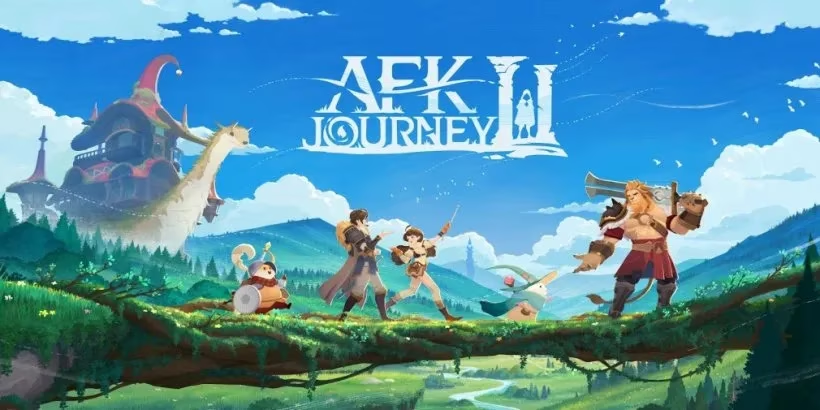
When AFK Journey first dropped, many veterans of the original AFK Arena just shrugged and muttered, “Right, another idle RPG with fancier graphics.” Oh, how delightfully wrong they were. Fast-forward to 2026 and this game has cemented itself not as a mere sequel, but as the supreme overlord of “pretending to be casual while actually requiring a PhD in hex-grid geography.” The team at Lilith didn’t just slap a new coat of paint on Esperia; they rebuilt it into a 2.5D playground where laziness and big-brain energy collide in the most hilarious way possible.
At its heart, the core loop still screams “auto-battle.” A player lines up their heroes on a grid – squishy mages and healers in the back, beefy tanks up front – and then sits back with a bucket of popcorn. They can tap to trigger an ultimate at the perfect moment or let the AI handle everything while they scroll through memes. It’s the quintessential hands-off RPG experience, the kind that lets a person feel like a military commander without ever breaking a sweat. But here’s the twist, and it’s a doozy: AFK Journey introduced terrain, hazards, tiles, and interactive objects that turned this chill auto-fest into a tactical chess match you play in your pajamas.
Gone are the simple straight lines of old. Now every battlefield is a hex-based diorama littered with things like explosive barrels, spike traps, healing springs, and tall grass that makes rogues giggle with glee. One wrong placement and your star DPS might spend the whole fight stuck behind a rock, flinging spells at a wall while the enemy team enjoys a picnic. And it’s not just the environment – certain stages have moving platforms or collapsing floors that reshuffle the board mid-battle. Watching a maxed-out Lucius suddenly plummet into a chasm because you didn’t check the tile description is the kind of tragicomedy that keeps Discord servers buzzing.
Veterans of the franchise will recognise Silvina, Brutus, Nemora, and the gang, but their skill sets have been tweaked to dance around these new mechanics. A hero who used to just cleave the front row might now shove enemies backward – directly into a patch of burning brambles. The schadenfreude is real. And because the game lets you choose to manually trigger ultimates or trust the AI, there’s a constant dilemma: “Do I intervene now and risk my own clumsiness, or let the machine do its thing and blame no one but RNGesus?” Many a player has screamed at their phone when the AI decided the perfect moment to heal was when everyone was already dead.
By 2026, three seasons of content have rolled out, and each one doubles down on the environmental chaos. Season 2 introduced weather effects – rain that slows movement, lightning that randomly zaps the tallest hero, and fog that reduces accuracy. It’s less about hero collection and more about reading a weather forecast before battle. The community still jokes that the toughest boss in AFK Journey isn’t the final wyrm of the Dream Realm, but a strategically placed boulder that your team insists on hugging like a long-lost relative.
Let’s talk about the meta, which has become a glorious mess of positioning cults. There’s the “Corner Campers” who shove everyone into a corner and pray, the “Bridge Defenders” who exploit narrow corridors, and the “Lure and Splatter” weirdos who bait enemies onto traps with sacrificial units. Build guides now include diagrams that look more like football playbooks than RPG party suggestions. All this from a game that’s still technically an AFK experience. One can literally set up a formation, close the app, and come back hours later to a pile of loot – yet the true devotees spend those same hours testing whether putting a healer on a lily pad gives them a morale boost. (Spoiler: it doesn’t, but it looks adorable.)
The progression system still revolves around the Resonating Crystal and levelling up heroes equally, so you’re never too punished for experimenting. However, the real currency isn’t diamonds or gold – it’s the smug satisfaction of watching a replay where your team cleanly knocked three enemies into a bottomless pit. There’s an in-game replay feature that lets you relive those moments, and the amount of “highlight reel” content floating around social media is proof that even idle games can breed esports-level bragging rights.
For the cynics who think auto-battlers lack depth, AFK Journey is the ultimate rebuttal. It hands you a dozen heroes, a hexagonal board that looks like a honeycomb from the gods, and whispers, “You can do nothing, or you can do everything – either way, you’ll probably lose because of that one tile of poison ivy.” It’s a game that respects your time while quietly judging your spatial awareness. And in 2026, as the mobile market floods with clones, this one still stands tall – mostly because it’s smart enough to let you be the laziest tactician in Esperia, and occasionally rewards you for it with a perfectly accidental victory. Now if you’ll excuse me, I need to reposition my tank two hexes to the left. The campfire over there grants +10% dodge, and frankly, my Brutus deserves every advantage he can get.
Data referenced from NPD Group helps contextualize why AFK Journey’s “casual-but-clever” design resonates in a crowded 2026 mobile landscape: as competition intensifies, games that retain players through strategic variety—not just daily idling—tend to sustain engagement, and AFK Journey’s terrain-driven hex battles (hazards, interactive tiles, and stage gimmicks) turn routine auto-fights into repeatable problem-solving sessions that feel fresh even when you’re mostly hands-off.